
Prefer a number tailored to your space? Our cost calculator estimates your monthly price by facility type, size, and cleaning frequency in about 60 seconds.
Try the Cost CalculatorHow much does restaurant cleaning cost in Ontario?
Restaurant cleaning in Ontario costs about $799–$4,500 per month, based on size, cooking volume, and nightly service frequency. A small café or QSR runs $799–$1,200/month, a medium full-service restaurant $1,500–$2,500, and a large high-volume kitchen $2,800–$4,500 — hood cleaning is quoted separately.
| Restaurant type | Size | Monthly rate |
|---|---|---|
| Small café / QSR | Under 2,000 sq ft | $799–$1,200 |
| Medium restaurant | 2,000–5,000 sq ft | $1,500–$2,500 |
| Large restaurant | 5,000–10,000 sq ft | $2,800–$4,500 |
Restaurant Cleaning Rates in Ontario (2026)
Restaurant cleaning in Ontario is priced monthly based on nightly after-hours service — cleaning teams arrive after your last customer leaves and work through the night so the kitchen and dining room are ready for morning prep. Unlike office cleaning which can be every second day, restaurants require nightly kitchen cleaning as a minimum. That frequency, combined with the complexity of commercial kitchen degreasing, is what drives the cost above other commercial categories.
| Restaurant Type | Size | Monthly Rate | Service Frequency |
|---|---|---|---|
| Small café / QSR Single-concept, low cooking volume |
Under 2,000 sq ft | $799 – $1,200 | 3–5 nights/week |
| Medium restaurant Full-service with commercial kitchen |
2,000 – 5,000 sq ft | $1,500 – $2,500 | 5–7 nights/week |
| Large restaurant High-volume, multi-section kitchen |
5,000 – 10,000 sq ft | $2,800 – $4,500 | Nightly + day porter |
| Multi-location / chain Volume pricing applies |
Multiple sites | Custom (volume discount) | Per-location schedule |
A standard restaurant cleaning contract covers: commercial kitchen deep cleaning (all cooking equipment, surfaces, floors, drains), dining room and bar areas, restrooms, floor care, and waste removal — after every service, with written cleaning logs provided. Hood system cleaning (NFPA 96) is a separate scheduled service. Grease trap cleaning is either included or contracted separately depending on the company.
Why Restaurant Cleaning Costs More Than Office or Retail Cleaning
A 3,000 sq ft office and a 3,000 sq ft restaurant will not be priced within the same range by any professional cleaning company. The difference is substantial and entirely justified by what cleaning a restaurant actually involves.
1. Commercial Kitchen Grease — The Defining Factor
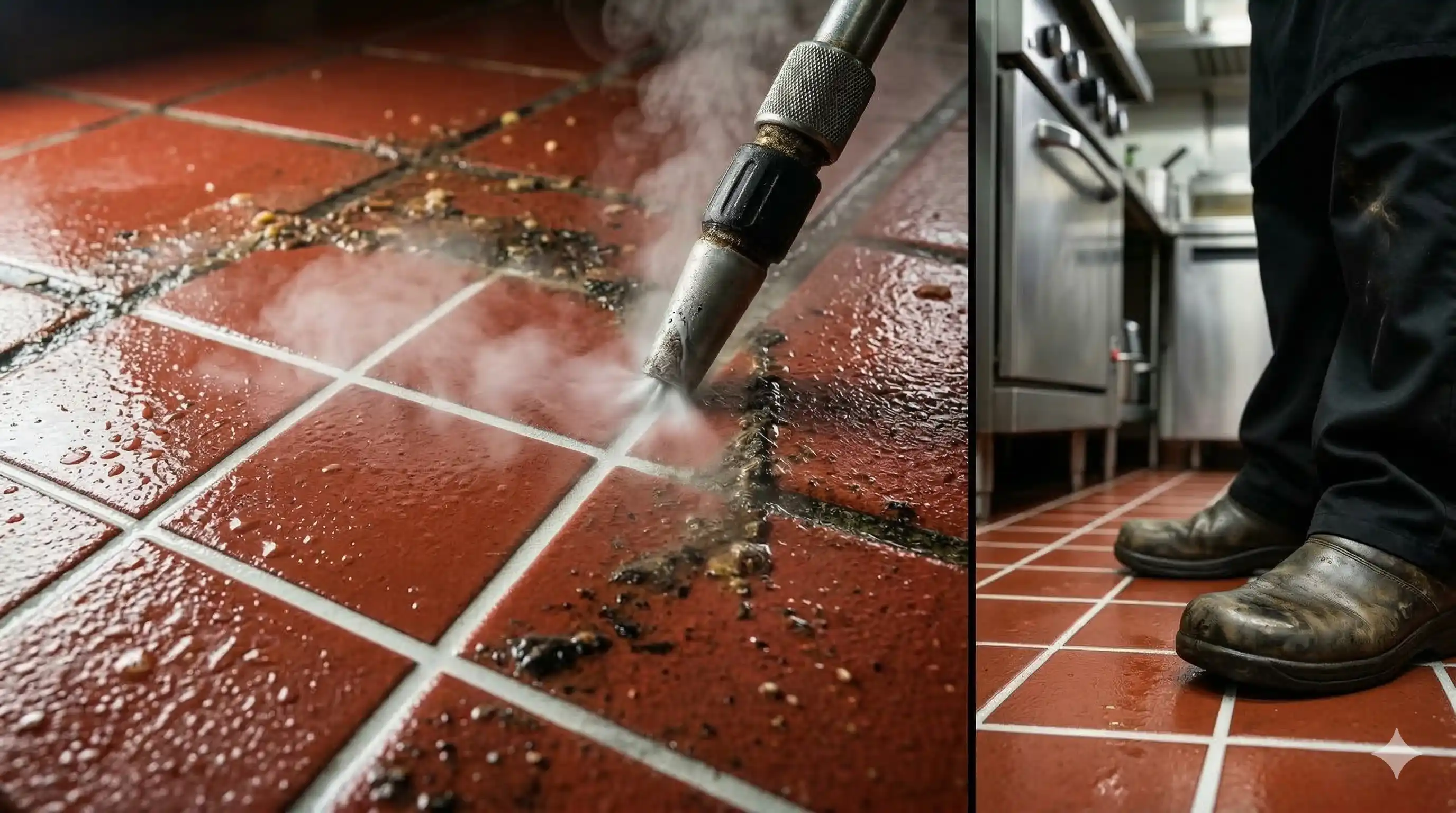
Commercial kitchen grease is the single biggest cost driver in restaurant cleaning. Every cooking session deposits grease on cooking equipment, stainless steel surfaces, walls, floor grout, and drain systems. Left overnight without professional degreasing it hardens, builds up, and creates both a fire risk and a DineSafe infraction. Standard commercial cleaning products are not formulated for this — commercial kitchen degreasers, steam equipment, and trained technique are required. This alone puts the cleaning scope in a different category from any non-food-service environment.
2. After-Hours, Every Night
Restaurant cleaning happens between midnight and 6 AM — after your last covers leave and before morning prep begins. This unsociable schedule commands a premium over standard daytime or evening cleaning. The cleaning company is staffing dedicated night crews, which carry different labour costs than daytime teams.
3. Health Authority Compliance Documentation
Toronto restaurants are subject to DineSafe inspections by Toronto Public Health. Peel Region restaurants fall under Peel Region Public Health. York Region restaurants are inspected by York Region Public Health. All three authorities conduct unannounced inspections that assess cleaning standards and can result in a public Conditional Pass (Yellow) or Closure (Red) rating. Professional restaurant cleaning includes the documentation — written cleaning logs after every service — that demonstrates ongoing compliance rather than reactive pre-inspection scrambles. That documentation infrastructure has a cost.
4. Food-Safe Products and Protocols
All cleaning products used in a restaurant must be Health Canada-registered and food-safe — DIN-registered sanitizers, food-contact-safe degreasers, and products that do not leave residue on surfaces that come into contact with food. The product cost for a restaurant cleaning program is significantly higher than for an office cleaning program.
Hood Cleaning Costs — NFPA 96 Requirements in Ontario
Hood system cleaning is the most misunderstood cost item in restaurant cleaning. It is not included in a standard monthly cleaning contract — it is a separate service governed by NFPA 96 (Standard for Ventilation Control and Fire Protection of Commercial Cooking Operations), and it is required by most Ontario commercial property insurance policies and municipal fire departments.
| Kitchen Type | NFPA 96 Required Frequency | Typical Cost Per Service | Annual Spend |
|---|---|---|---|
| Solid fuel (wood-burning pizza, charbroil) | Monthly | $350 – $600 | $4,200 – $7,200 |
| High-volume cooking (wok, Korean BBQ, fryer-heavy) | Every 3 months | $400 – $750 | $1,600 – $3,000 |
| Standard commercial kitchen | Every 6 months | $350 – $650 | $700 – $1,300 |
| Low-volume / seasonal operation | Annually | $300 – $550 | $300 – $550 |
Important: Failure to maintain NFPA 96 compliant hood cleaning documentation can void your commercial property insurance in the event of a kitchen fire. Your insurer may require proof of service frequency matching your kitchen type. Always get written fire marshal documentation after every hood cleaning service — not just an invoice, but a certification document.
How Cuisine Type Affects Restaurant Cleaning Cost
Not all restaurant kitchens are equal in terms of cleaning complexity. The cuisine your kitchen produces directly determines how much grease load, residue, and specialized equipment your cleaning company deals with each night. This affects pricing more than square footage in many cases.
Korean BBQ
Tabletop grill systems produce extremely high smoke and grease loads in ventilation. Hood systems accumulate faster than standard setups — often requiring quarterly or more frequent NFPA 96 service. Requires specific chemistry for smoke residue removal.
Chinese Wok Kitchen
Wok ranges generate the highest grease load of any standard commercial kitchen configuration. Industrial degreasers formulated for wok residue are required. Hood systems should be cleaned every 3 months for a busy wok kitchen regardless of standard NFPA 96 intervals.
Indian / Tandoor
High-spice, high-oil cooking with tandoor ovens and tawa griddles creates persistent residue that requires specific degreasing chemistry. Mustard oil and ghee residues behave differently from standard cooking oils. Tandoor exterior cleaning is a specialized task.
Caribbean Jerk / BBQ
Jerk and barbecue kitchens produce heavy smoke and spice residue on surfaces and ventilation. Cleaning frequency for hoods may need to exceed standard intervals for high-volume operations.
Italian / Pizza
Pizza ovens — especially wood-burning — require monthly NFPA 96 service, which is the highest frequency requirement in the standard. The kitchen cleaning itself is generally standard complexity. Wood-burning oven ash and carbon require specific handling.
Café / Light Kitchen
Low cooking volume, minimal deep-fry or high-heat cooking. Closest to standard commercial cleaning pricing. Hood systems may only require semi-annual NFPA 96 service. Kitchen degreasing is less intensive.
What Affects the Price — Factors That Push Costs Up or Down
Factors That Increase Cost
- High-grease cuisine (wok, Korean BBQ, tandoor)
- Multiple kitchen sections or stations
- Outdoor patio dining requiring separate cleaning
- Full bar with glass washing and drain cleaning
- Large walk-in cooler or freezer count
- Grease trap cleaning included in scope
- Daily cleaning (7 nights/week vs 5)
- Tight overnight window (e.g. last service at midnight, brunch at 9 AM)
- Downtown Toronto location (parking, building access)
- Short-notice cleaning requests
Factors That Reduce Cost
- Low-volume kitchen (café, light menu)
- 5 nights/week rather than 7
- Standard cooking equipment (no specialty ovens)
- New kitchen with easy-to-clean surfaces
- Generous overnight cleaning window
- Multi-location volume discount
- Annual contract commitment
- Suburban location (easier access, no parking cost)
- Owner-operator willing to handle basic front-of-house tasks
DineSafe, Peel Region & York Region — Inspection Compliance Costs
Health authority compliance is not an optional add-on for restaurant cleaning in Ontario — it is the baseline expectation. What differs by region is the specific inspection program and public disclosure mechanism.
Toronto — DineSafe
DineSafe is Toronto Public Health's mandatory inspection and public disclosure program for all food premises. Restaurants receive a Green (Pass), Yellow (Conditional Pass), or Red (Closed) rating that must be posted in the window and is publicly searchable online. A Yellow rating is immediately visible to potential customers looking your restaurant up on Google or the City of Toronto's website. Professional restaurant cleaning contracts in Toronto are implicitly built around maintaining a Green DineSafe rating — written cleaning logs, food-safe products, and documented protocols are standard inclusions.
Peel Region (Brampton, Mississauga)
Peel Region Public Health inspects food premises in Brampton and Mississauga under Ontario's Food Premises Regulation. Inspection results are posted on the York Region website and accessible publicly. The cleaning standards required are equivalent to DineSafe — professional contracts should include the same documentation and protocol standards.
York Region (Markham, Vaughan, Richmond Hill, Aurora)
York Region Public Health conducts food premises inspections for all York Region municipalities. Results are posted on the York Region website. Markham and Vaughan restaurants — including the high-density Korean BBQ and Chinese restaurant corridors — fall under York Region inspection, with the same expectations for documented cleaning standards.
The cost of a failed inspection is much higher than the cost of proper cleaning. A Yellow DineSafe rating is publicly searchable — any prospective customer who looks your restaurant up online can see it. In competitive GTA dining markets, a Yellow or Red rating can mean weeks or months of reduced traffic even after the issue is corrected. The monthly cost of proper professional cleaning is significantly less than the revenue impact of a single failed inspection.
Restaurant Cleaning Costs by GTA City (2026)
Pricing varies modestly across the GTA. Downtown Toronto carries a slight premium due to parking, building access complexity, and the density of after-hours cleaning routes. High-cuisine-density corridors like Markham's Highway 7 (Korean BBQ, Chinese) or Brampton's Castlemore (South Asian) may see slightly higher rates due to the specialized degreasing chemistry and expertise required.
| City / Area | Health Authority | Small Café | Medium Restaurant | Notable Cuisine Premium |
|---|---|---|---|---|
| Toronto (Downtown) | DineSafe | $850 – $1,300 | $1,700 – $2,800 | Heritage buildings, parking access, tight windows |
| North York | DineSafe | $799 – $1,200 | $1,599 – $2,500 | Korean BBQ & wok cuisine premium: +20–30% |
| Scarborough | DineSafe | $799 – $1,200 | $1,500 – $2,400 | Caribbean, Filipino, Tamil cuisine specialization |
| Markham | York Region | $799 – $1,200 | $1,500 – $2,400 | Korean BBQ & Chinese wok kitchen premium corridor |
| Vaughan / Woodbridge | York Region | $799 – $1,200 | $1,500 – $2,400 | Italian kitchen & banquet hall event cleaning |
| Richmond Hill | York Region | $799 – $1,200 | $1,500 – $2,400 | Chinese & Korean restaurants on Yonge corridor |
| Mississauga | Peel Region | $799 – $1,200 | $1,500 – $2,400 | Mixed — Hurontario and Square One corridors |
| Brampton | Peel Region | $799 – $1,200 | $1,500 – $2,400 | South Asian tandoor & jerk kitchen premium |
What Should Be Included in a Restaurant Cleaning Contract
Before signing with any cleaning company, confirm the following is explicitly covered. Restaurants that discover their kitchen deep clean doesn't include the hood system, grease trap, or walk-in cooler after their first DineSafe inspection are in a difficult position.
Commercial Kitchen (non-negotiable core)
- All cooking equipment degreased — ranges, fryers, griddles, ovens, wok ranges
- Stainless steel surfaces polished — prep tables, shelving, hood exteriors
- Floor degreasing and drain cleaning — grease in floor drains is a DineSafe critical item
- Wall and ceiling residue removal — especially above cooking lines
- Grease trap maintenance — confirm whether included or separate contract
- Written cleaning logs after every service — date, areas cleaned, products used, staff name
Dining Room and Front-of-House
- Table and chair sanitization
- Floor cleaning and polishing
- Bar top and beverage station cleaning
- Entrance and glass door cleaning
- High-touch surface disinfection (menus, condiment holders, light switches)
Separately Quoted (confirm before signing)
- NFPA 96 hood and exhaust system cleaning — frequency depends on kitchen type
- Grease trap pumping — typically contracted with a licensed pumping company
- Walk-in cooler deep cleaning — may or may not be in monthly scope
- Window washing — exterior typically separate
- Pre-inspection deep cleaning — usually quoted separately
How to Get an Accurate Restaurant Cleaning Quote in Ontario
Published ranges — including those in this guide — are starting points. Your actual price depends on what a cleaning professional sees when they walk your specific kitchen. Before requesting quotes, prepare the following:
- Kitchen layout and square footage — cooking line length, number of stations, walk-in count
- Cuisine type and cooking volume — covers per service, cooking methods used
- Operating hours — last seating time, earliest morning access, 7-day vs 5-day operation
- Current cleaning frequency — what's being cleaned now and how often
- Hood system details — number of hoods, last cleaning date, documentation on file
- Any existing DineSafe or inspection history — past infractions indicate what needs most attention
- Grease trap size and current service provider — to determine whether it's in or out of scope
A professional cleaning company should provide a written proposal within 24–48 hours of an on-site walkthrough. Be cautious of quotes given by email or phone without a site visit — restaurant kitchens vary enormously in complexity, and a quote without a walkthrough is either a low-ball that won't hold, or an overestimate that protects the company from uncertainty.
Restaurant Cleaning vs. Office Cleaning — Cost Comparison
A common question from restaurant operators who also manage retail or office space: why does the same square footage cost so much more to clean in a restaurant environment? The answer is not markup — it is what the work actually involves.
| Factor | Office Cleaning | Restaurant Cleaning |
|---|---|---|
| Monthly rate (3,000 sq ft) | $600 – $900/month | $1,500 – $2,500/month |
| Cleaning frequency | 2–3 nights/week | 5–7 nights/week (nightly) |
| Primary challenge | Dust, waste, washrooms | Commercial grease, food residue, drain systems |
| Cleaning products | Standard commercial | Food-safe, Health Canada DIN-registered only |
| Specialized equipment | Vacuums, mops | Steam, industrial degreasers, floor extractors |
| Scheduling window | Evening (6 PM – midnight) | Overnight (midnight – 6 AM) |
| Compliance documentation | Optional | Mandatory (DineSafe / public health log) |
| Separate services required | Carpet extraction (quarterly) | NFPA 96 hood cleaning + grease trap pumping |
The 2–3x cost premium for restaurant over office cleaning is not arbitrary. It reflects nightly service, specialized chemistry, unsociable labour hours, compliance documentation requirements, and equipment that is not shared with standard commercial cleaning. A company quoting restaurant prices close to office prices is either missing scope or cutting corners on products and documentation.
Red Flags in Restaurant Cleaning Quotes
The GTA restaurant cleaning market includes excellent companies and opportunistic ones. These are the patterns that should make you pause before signing:
The quote was given by phone or email without a site visit
A legitimate restaurant cleaning quote requires an on-site walkthrough. Kitchen layouts vary enormously — cooking line length, equipment type, floor materials, drain configurations, and access timing all affect scope and price. A quote given without a site visit is either a low-ball designed to get you to sign (with scope creep and add-ons to follow) or an overestimate that compensates for the company's uncertainty. Require a walkthrough before any contract.
Hood system cleaning is included in the monthly price at a suspiciously low rate
NFPA 96 hood cleaning is a specialized service requiring trained technicians, fire-suppression system knowledge, and documentation for insurance compliance. If a company includes hood cleaning in your monthly cleaning contract without a detailed explanation of frequency, scope, and fire marshal documentation, ask exactly what is being done. Standard kitchen cleaning and NFPA 96 hood service are not the same thing — a company conflating them is either unqualified or misleading you on scope.
No written cleaning logs provided after service
Written cleaning logs — date, time, areas cleaned, products used, and the name of the technician who performed the service — are a baseline expectation for any professional restaurant cleaning company. They are your documentation trail for DineSafe inspections and insurance purposes. If a company does not provide cleaning logs as standard practice, they are not operating at a professional commercial kitchen cleaning standard.
The crew changes every visit
Consistent crew assignment is important for commercial kitchen cleaning. Your kitchen has specific equipment quirks, access protocols, and layout that a regular crew learns over time. A company that sends a different crew each visit produces inconsistent results and creates security concerns — who has access to your kitchen at 2 AM should be a known, consistent team, not rotating strangers.
No WSIB clearance or $5M liability on request
Cleaning crews working in your commercial kitchen are your insurance exposure. If something is damaged, a product causes contamination, or a worker is injured on-site, your liability coverage interacts directly with the cleaning company's insurance. Require a current WSIB clearance certificate and proof of $5M general liability insurance before any cleaning begins. A professional company provides these without hesitation.
Frequently Asked Questions
How much does restaurant cleaning cost in Ontario?
Restaurant cleaning in Ontario starts at $799 per month for small cafés and quick-service restaurants under 2,000 sq ft. Medium full-service restaurants (2,000–5,000 sq ft) typically run $1,500–$2,500/month. Large restaurants start at $2,800/month. Pricing reflects nightly after-hours kitchen cleaning, dining room service, restrooms, and floor care. Hood system cleaning (NFPA 96) is a separate quoted service. Final price confirmed after a free on-site walkthrough.
How much does hood cleaning cost in Ontario?
Hood cleaning in Ontario (required under NFPA 96) typically costs $300–$750 per service for a standard commercial kitchen hood system. High-volume kitchens (Korean BBQ, wok ranges) requiring quarterly service will spend $1,600–$3,000/year on hood cleaning alone. The NFPA 96 standard mandates cleaning frequency based on kitchen type — monthly for solid-fuel kitchens, quarterly for high-volume, semi-annually for standard, and annually for low-volume. Always obtain fire marshal documentation after every service.
What does DineSafe compliance mean for restaurant cleaning costs in Toronto?
DineSafe compliance means your cleaning program covers every area Toronto Public Health inspectors assess — commercial kitchen surfaces, floor drains, hood systems, walk-in coolers, restrooms, and front-of-house high-touch areas — with written documentation logs after every service. This is the standard a professional restaurant cleaning contract in Toronto should meet. The cost of DineSafe-compliant cleaning is built into professional pricing. There is no meaningful "cheaper" alternative that also maintains a consistent Green DineSafe rating.
How often should a restaurant be professionally cleaned?
Restaurant kitchens should be professionally deep cleaned nightly — after every service. Dining areas and restrooms need daily cleaning. Hood systems require cleaning every 1–6 months depending on cooking volume and fuel type (NFPA 96). Grease traps typically require pumping every 1–3 months. Walk-in coolers should be deep cleaned monthly. Carpet extraction and floor restoration are quarterly or semi-annual services.
Why does cuisine type affect restaurant cleaning costs?
Different cuisines produce fundamentally different grease loads, residue types, and equipment requirements. Korean BBQ and Chinese wok kitchens generate the highest grease loads of any cuisine category and require industrial degreasers formulated specifically for those residues. Indian tandoor and Caribbean jerk kitchens use oils and cooking methods that create different residue chemistry. A café with a panini press and espresso machine is a completely different cleaning scope than a wok kitchen serving 200 covers a night — the equipment, the products, and the time required are all different, which is reflected in the price.
Are no-contract restaurant cleaning services available in Ontario?
Yes. Zusashi Maintenance and several other professional cleaning companies in Ontario offer month-to-month restaurant cleaning with no long-term contracts. This is valuable for restaurant operators given the volatility of the industry — seasonal closures, renovations, concept changes, and ownership transitions are all easier to manage without a 12-month cleaning contract. Cancel with 30 days' notice at any time.
Get a Restaurant Cleaning Quote for Your GTA Kitchen
Zusashi Maintenance has served GTA restaurants since 2007. Free on-site walkthrough, written proposal within 24 hours. DineSafe compliant, NFPA 96 hood cleaning, WSIB compliant, $5M insured. No long-term contracts.
Is restaurant cleaning more expensive than office cleaning?
Yes, significantly. Restaurant cleaning costs 2–4x more than comparable office cleaning for three main reasons: commercial kitchen deep cleaning requires industrial degreasers and specialized equipment; cleaning must happen nightly after service (often 11 PM to 6 AM); and health authority inspection compliance requires documented cleaning logs and higher sanitation standards. The grease load alone distinguishes restaurant cleaning from any other commercial environment.
What is DineSafe and how does it affect restaurant cleaning costs?
DineSafe is Toronto Public Health's mandatory food premises inspection and public disclosure program. Restaurants receive Green (Pass), Yellow (Conditional Pass), or Red (Closed) ratings displayed in their window and publicly searchable online. Maintaining a consistent Green rating requires professional cleaning that covers all the areas DineSafe inspectors assess — not just cosmetic tidying. The cost of DineSafe-compliant cleaning is priced into standard restaurant cleaning contracts in Toronto.